Hardwood Floor Refinishing, Sioux City Metro
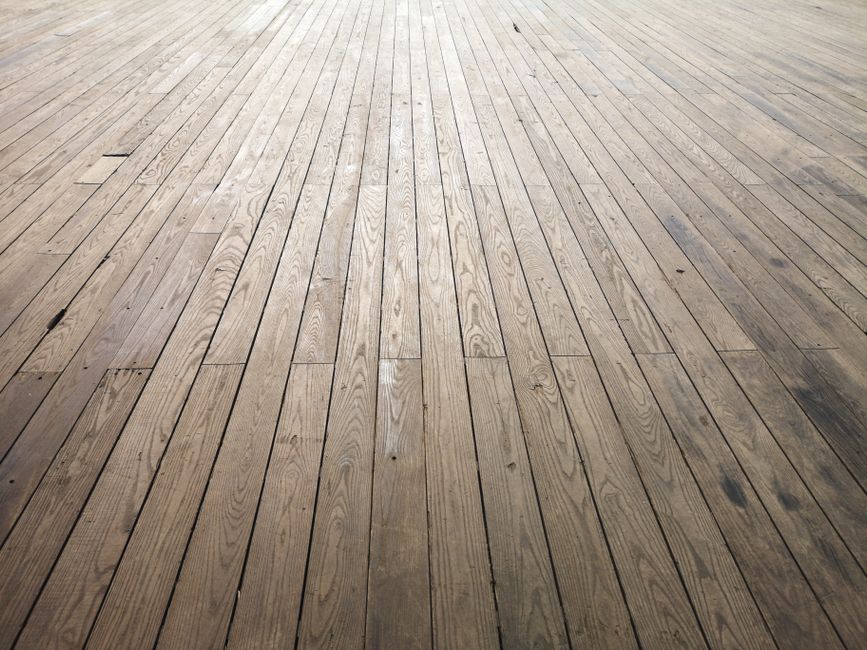
What hardwood floor refinishing means
Hardwood floor refinishing means sanding a wood floor down to bare wood and applying a new finish, rather than working around the finish that's already there. NWFA (the National Wood Flooring Association) describes a complete sand and refinish as the step that's "recommended when there is damage to the wood floor like deep scratches, dents, and other flooring damage," and also when "the finish has worn away, and the bare wood is exposed" (NWFA, "Refinishing Your Floors," woodfloors.org, as of 2026).
That's a different service from a screen and recoat, which cleans and lightly abrades the existing finish and adds a fresh coat without removing the old finish layer down to wood. It's also different from spot restoration and repair work on gouges, dents, water stains, or a few damaged boards, which doesn't always call for sanding the whole room. Refinishing is the one service that reaches bare wood across the whole floor, which is also the only point at which the floor's color can realistically be changed — NWFA notes that "sanding a floor back to raw wood is the perfect opportunity to change the color of the floor" (NWFA, "Refinishing Your Floors," as of 2026). See staining and color change for how that works once a floor is down to bare wood.
The sand-to-finish process
The underlying process hasn't changed much over the decades. A USDA Forest Products Laboratory and Purdue University extension publication on finishing and maintaining wood floors describes floors being sanded "in successive cuts from coarse to fine," typically two cuts, or three if the floor is uneven (USDA FPL / Purdue, Finishing and Maintaining Wood Floors, 1980). The same publication is blunt about restraint: "Do not remove more wood than absolutely necessary." Most strip flooring is about ¾ inch thick, which is why it "can withstand a number of sandings" over its life — but a thinner floor, or hardwood plywood, needs more care to avoid sanding through the wear layer, and its actual thickness can usually be checked by pulling a floor heating register or the shoe mold and baseboard to expose an edge (USDA FPL / Purdue, 1980). That 1980 publication predates today's finish products, so treat it as background on the wood-science and sanding principles involved, not as guidance on which specific products or coatings to use.
After the bare-wood sanding cuts, the specific grit sequence for the final pass depends on which finish system goes down next — see floor sanding for the grit ranges two current manufacturer data sheets specify. Once the surface is prepared, a sealer or stain may be applied (see staining and color change), followed by the finish coats themselves. The USDA/Purdue publication also notes that "when surface finishes must be renewed, it is usually necessary to refinish the entire room," and that finishes "are best renewed when they begin to show signs of wear in traffic channels but before the bare wood is exposed" — and separately warns that wax residue "may interfere with the drying and adhesion of any new finish" (USDA FPL / Purdue, 1980), which is why any existing wax or polish has to be dealt with before new finish goes down.
Stairs
Stairs are part of the same refinishing job as the surrounding floor rather than a separate service, and the only piece of stair-specific data in the sourced cost guides is the per-step price. Two national guides publish different ranges:
| Source | Per-step stair refinishing cost |
|---|---|
| HomeGuide, "How Much Does It Cost to Refinish Hardwood Floors? (2026)" | $25–$85 per step |
| Thumbtack, "2026 Hardwood Floor Refinishing Cost" (last updated July 8, 2026) | $80–$140 per step |
Those two national figures don't agree with each other, which is typical of the cost guides generally (see the cost section below). Beyond the per-step price, none of the sources reviewed for this site — not NWFA, not a manufacturer data sheet, not the USDA publications — describe a stair-specific sanding or finishing process, so none is claimed here; the general sand-to-finish process described above applies.
Refinishing, restoration, and a screen and recoat
It helps to think of these as three different points on the same spectrum, from lightest to most involved:
- Screen and recoat — the finish itself is still in reasonably good shape; the job is cleaning, a light abrasion of the existing finish, and a new top coat. See screen and recoat for what that involves and when NWFA and a manufacturer's own materials say it applies instead of a full refinish.
- Restoration and repair — specific damage (a gouge, a water stain, a section of boards) is addressed without necessarily resanding the whole room. See restoration and repair for repair cost ranges and how dark water stains are typically explained.
- Refinishing — the entire floor is sanded to bare wood and a full finish system is reapplied. This is the option when the finish has worn through, when damage runs across more than a small area, or when the color is changing.
A more detailed comparison of the recoat option against a full refinish, including the timing NWFA and a manufacturer describe for each, is in screen-and-recoat vs full refinish.
What refinishing costs
National consumer cost guides don't agree with each other on price, and none of them describe what any specific contractor in the Sioux City area charges — they're general references, not local quotes. Angi's guide (updated August 3, 2026) lists professional refinishing at $3–$8 per square foot, with an average project cost of $1,892 and a typical range of $1,107–$2,681. Thumbtack (last updated July 8, 2026) reports a national average range of $1,498–$3,763, with most customers paying about $2,372 based on its own platform data — noticeably higher than Angi's average. A full breakdown by square footage and by wood species, along with a third guide's numbers, is on cost to refinish hardwood floors.
How long the job takes
Refinishing takes longer than a screen and recoat because the floor has to be sanded to bare wood, then given time to dry and cure between coats before it can be used normally again. Drying and curing times differ by finish product and are covered in detail, with the manufacturer data behind them, on how long refinishing takes.
Finish types
Once a floor is sanded to bare wood, the finish applied is either water-based or oil-based (along with a few less common options), and the two categories differ in appearance, VOC content, and dry time. NWFA's summary and the federal VOC limits that apply to floor coatings are covered in water-based vs oil-based finish.
Refinish or replace
Not every floor is a refinishing candidate, and not every homeowner comparing refinishing against new flooring is looking at the same trade-offs. Refinish or replace covers wear-layer thickness, the 2022 National Association of REALTORS® resale-value figure for refinishing, and what to weigh against installing new hardwood.
Service area
This site connects homeowners across the Sioux City metro to the service areas page, which lists the Iowa towns covered.
Requesting a refinishing quote
A refinishing quote is most useful with a few details ready ahead of time: the room or rooms involved and an approximate square footage, whether stairs are part of the project, the floor's current condition (a dulling finish, deep scratches, water stains, or bare wood already showing), and whether the color should stay the same or change. None of that requires deciding on a specific finish product or sheen in advance — that can be worked out once quotes are in hand.
To start a request, use the request a quote page.