Hardwood Floor Refinishing in Le Mars, Iowa
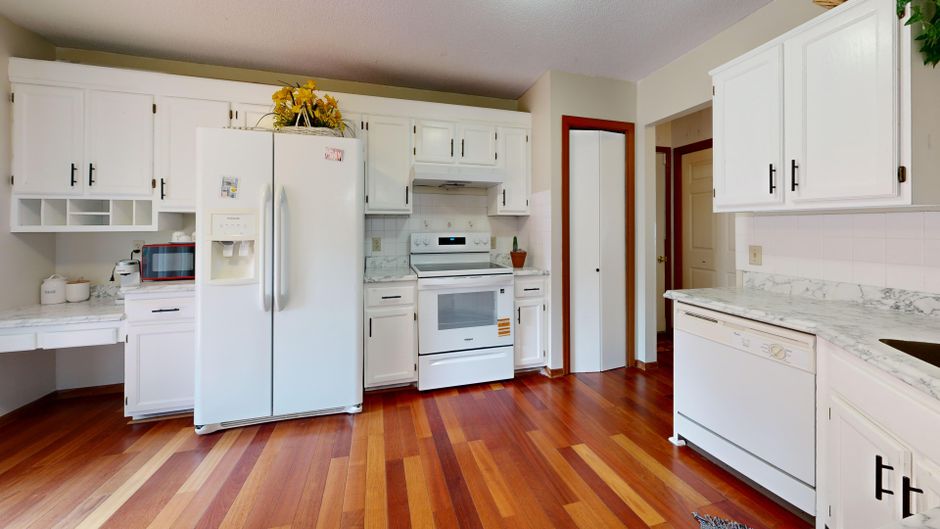
Le Mars is the Plymouth County seat and, outside Sioux City itself, the largest town in this site's six-town service area. The U.S. Census Bureau's 2020-2024 American Community Survey puts the city's median year of construction at 1975 (±3 years) — newer than Sioux City, older than Sergeant Bluff, and closer to the middle of the range across the towns this site covers.
Le Mars's housing, by the numbers
- Population: 10,674 (Census Bureau Vintage 2024 estimate), up from 10,571 at the 2020 Census.
- Housing units: an estimated 4,512 (ACS 2020-2024, ±226).
- Median year built: 1975 (±3).
- Owner-occupied: 61.5% of occupied housing units.
- Single-family detached: 63.4% of all housing units.
A median construction year in the mid-1970s puts a large share of Le Mars's housing stock past the point where solid strip hardwood was still the default underlayment in new residential construction in this region, but well before engineered and prefinished products became as common as they are in newer towns like Sergeant Bluff. A 1970s-built Le Mars home is a reasonable candidate for either solid hardwood under a later floor covering or an original wood floor that's simply due for attention — the only way to know which is to have the specific floor looked at.
County seat since 1872
Plymouth County was organized in 1853. According to the City of Le Mars's own history page, the town itself was platted in 1869, and the county seat moved there from Melbourne in 1872 after a close vote. The city's name traces to that same founding period: Le Mars was named in 1869 by combining the first initials of six women's first names — Lucy, Elizabeth, Mary, Anna, Rebecca and Sarah — who had accompanied railroad builder John I. Blair. The same source describes the town growing from that platting to a city of roughly 4,000 residents within about two decades. A British colony also settled in Le Mars beginning in 1876, part of the town's early growth.
That founding history — a railroad-era town platted in 1869, made a county seat in 1872, and built out substantially by the late 1800s — is consistent with a housing stock that includes real 19th- and early-20th-century construction even though the citywide median lands in the 1970s. A median reflects the whole distribution of homes in the city, not a single era; Le Mars very likely has both an older core near its historic downtown and newer residential growth from the following century, and the 1975 median sits somewhere between those two stories rather than describing either one directly.
What that means for a refinishing estimate here
Because Le Mars's housing spans a wide range of construction eras — from the town's 1869 founding through mid-1970s and later development — a floor's age and likely condition depend heavily on which part of town and which era of construction a specific home falls into, more so than in a town with a tighter, more uniform median year like Sergeant Bluff. A home near Le Mars's historic core may hold original solid hardwood under a later carpet or vinyl layer; a home from the newer end of the range may have started with an engineered or prefinished product instead, or with hardwood limited to specific rooms. Both are common outcomes for a county seat that's been continuously built up for a century and a half.
Le Mars's 1975 median also sits in a useful middle position among the six towns this site covers. It's newer than Sioux City's 1957 median and Sergeant Bluff's newer 1996 median falls on the other side of it entirely, while Hinton (1981), Moville (1970) and Lawton (1980) all cluster within a few years of Le Mars's own figure. That clustering suggests a similar mid-20th-century wave of construction touched several of this area's smaller towns around the same decades, even though each town's founding history is different. For Le Mars specifically, the practical takeaway is the same one that applies across the service area: a townwide median describes a distribution, not any individual house, and it's most useful as a starting expectation rather than a substitute for having a specific floor examined.
A refinishing estimate for a Le Mars home typically starts with the same basic questions regardless of the home's likely construction era: whether the existing floor is solid or engineered wood, how much of its wear layer is left, and what condition the finish is currently in. Those questions matter more to the outcome than the town's median year alone, which is why this site treats housing-age data as useful context rather than as a prediction about any specific property.
For a look at what a specific Le Mars floor is made of and whether it's a good candidate for sanding and refinishing, call 908-493-5028.