Hardwood Floor Refinishing in Sergeant Bluff, Iowa
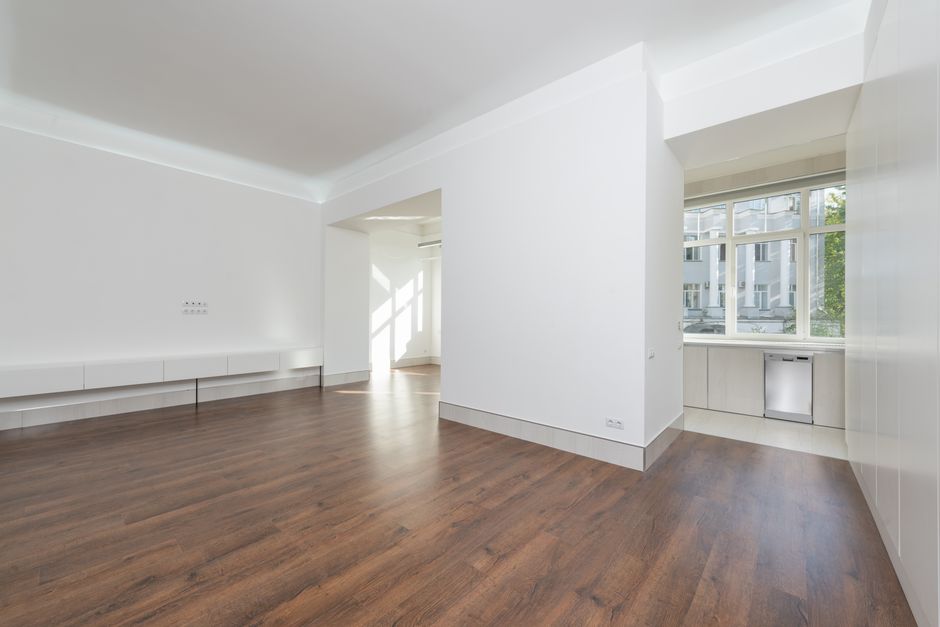
Sergeant Bluff's housing stock looks almost nothing like Sioux City's a few miles north. The U.S. Census Bureau's 2020-2024 American Community Survey puts the city's median year of construction at 1996 (±7 years) — decades newer than the anchor city, and newer than every other town in this six-town service area. That difference changes what a refinishing job here usually involves, not just how old a given floor is.
Sergeant Bluff's housing, by the numbers
- Population: 5,335 (Census Bureau Vintage 2024 estimate), up from 5,015 at the 2020 Census.
- Housing units: an estimated 1,957 (ACS 2020-2024, ±176 — a wide relative margin for a city this size, so treat the figure as a range rather than a precise count).
- Median year built: 1996 (±7).
- Owner-occupied: 73.2% of occupied housing units.
- Single-family detached: 60.0% of all housing units.
A home built around 1996 in this region was far more likely to leave the builder with a prefinished or engineered hardwood product, or to use hardwood only in select rooms — an entry, a dining room, a kitchen — with carpet or another material through the rest of the house, than to be floored wall-to-wall in site-finished solid strip oak the way an older Sioux City home often was. That doesn't make refinishing irrelevant in Sergeant Bluff; it changes the starting question. An engineered floor's wear layer, not its age, decides whether it can be sanded again at all, and it's a different question from the one a solid strip floor raises.
That distinction matters because the two floor types don't respond to sanding the same way. A solid wood floor, of the kind more common in Sioux City's older housing, is generally thick enough through the wear layer to be sanded and refinished multiple times over its working life. An engineered floor's hardwood layer sits on top of a plywood or composite core, and how many times it can be sanded — if at all — depends entirely on how thick that top layer is, not on the year the house was built. In a city where the median home postdates 1996, that's the more common question to start with.
A town platted before Sioux City's own charter
Sergeant Bluff's history predates its newer housing stock by well over a century. According to the city's own history page, the Sioux, Sac and Fox ceded the territory along the Missouri River's eastern shore on July 15, 1830. William Thompson and two other settlers arrived south of the Floyd Monument in the summer of 1848, and a village began to take shape in 1852, a year after Woodbury County itself was organized. The town — then registered as "Sergeant's Bluff City" — was formally platted on November 20, 1854, which the city's own page describes as the first formally platted town in Woodbury County. Sergeant Charles Floyd of the Lewis and Clark expedition — whose burial site is also a landmark in Sioux City — was reburied at the bluff in a 1895 ceremony marking the anniversary of his death; the 100-foot Floyd Monument itself was built afterward, completed in 1901 (National Park Service, Sergeant Floyd Monument).
That gap between an 1850s town founding and a 1990s median construction year says more about when the town grew than about when it started. Sergeant Bluff existed as a platted town for well over a century before most of its current housing stock went up — the population and housing-unit growth reflected in the Census figures above happened comparatively recently, as the town grew into a Sioux City-area suburb rather than as an early-settlement core the way Sioux City's own oldest neighborhoods did. A visitor standing at the Floyd Monument today is looking at a monument completed in 1901, marking an 1804 burial and an 1895 reburial, inside a town whose homes, on the whole, are far younger than any of those dates.
What that means for a refinishing estimate here
Because so much of Sergeant Bluff's housing is newer construction, a refinishing estimate here is more likely to start with questions about what's actually installed — solid or engineered, full wear layer or thin veneer, single species or a mixed floor with tile or carpet transitions — than with an assumption that an original solid floor is waiting under the current surface. That's a different conversation than the one in a town with an older median year of construction, and it's worth having before assuming a Sergeant Bluff home either definitely can or definitely can't have its existing floor sanded and refinished rather than replaced.
That's also a useful contrast with Sioux City, the anchor town just a few miles north: where Sioux City's older housing stock more often means checking for solid wood under a later floor covering, Sergeant Bluff's newer stock more often means confirming what type of hardwood is already installed before deciding whether it can be resanded at all. Neither question has a townwide answer — both come down to the specific floor.
For a look at what a specific Sergeant Bluff floor is made of and whether it's a candidate for refinishing, call 908-493-5028.