What to Do Before a Hardwood Floor Refinishing Job Starts
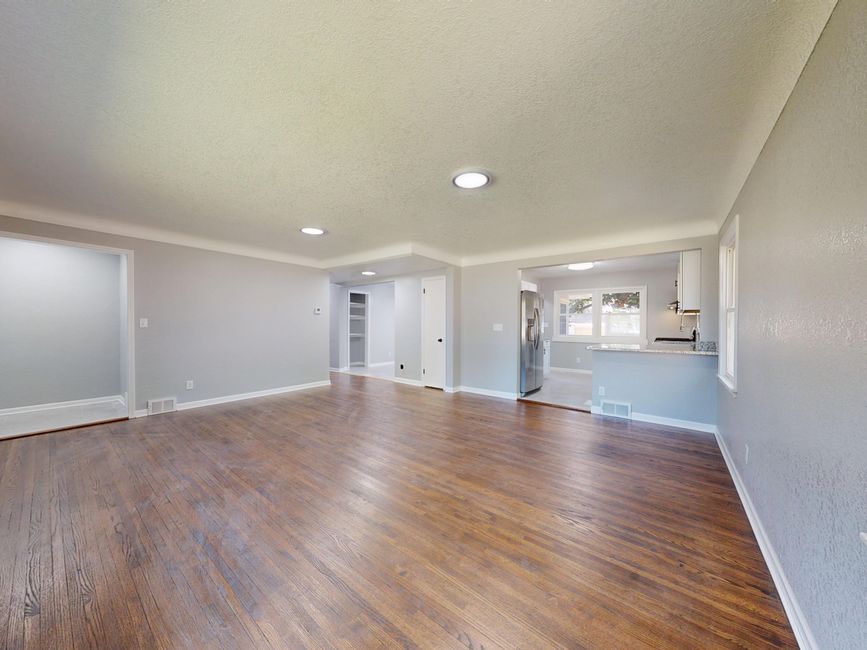
A refinishing job goes more smoothly when the room is ready for it before work begins, and the conditions inside the home during the job affect how the finish actually cures. Two things matter most going in: giving the space the airflow and temperature range the finish product needs, and, in an older home, understanding what Iowa's own lead-safe renovation rule does and doesn't say about work like this.
Ventilation, temperature, and humidity during the job
Manufacturer data sheets for wood floor finishes are specific about the conditions they need to perform as designed. Bona's technical data sheet for its Traffic HD finish, dated May 27, 2026, recommends a job-site environment of 65–80°F and 40–60% relative humidity. Minwax's data sheet for its oil-based Super Fast-Drying Polyurethane for Floors gives its stated dry times — at least 6 to 8 hours between coats — based on thin coats, good ventilation, and a baseline of 77°F and 50% relative humidity; its water-based Ultra Fast-Drying product assumes the same 77°F/50% baseline. Ventilation isn't a minor detail here — an older USDA Forest Products Laboratory and Purdue University publication on finishing and maintaining wood floors lists "provide adequate ventilation" as a basic part of getting a finish job right. Whichever finish ends up being used, keeping the room within the range its own data sheet calls for, and keeping air moving through it, is what the manufacturers themselves build their dry and cure times around. For how those numbers translate into an actual day-by-day schedule, see how long refinishing takes, and for how the choice between a water-based and an oil-based product affects both the timeline and the conditions it depends on, see water-based vs oil-based finish.
That same 1980 USDA/Purdue publication also notes a practical way to get a sense of a floor's thickness before sanding begins, without guesswork: pulling a floor heating register, or the shoe mold and baseboard, exposes an edge of the flooring where its actual thickness can be seen. That's a useful thing to know going in on an older floor, since thinner flooring and hardwood plywood need more careful handling during sanding than standard ¾-inch strip flooring does.
Clearing the room, and what happens right after the last coat
Getting furniture, rugs, and breakables out of the room ahead of time keeps the space clear for sanding and finishing work, and it matters after the job too — Bona's data sheet for Traffic HD specifically instructs not to replace area rugs until the floor has fully cured, not just until it's dry enough to walk on. The finish can be safe to walk on well before it's fully cured, and the data sheet notes it "remains susceptible to scuffing or marring" during that in-between period, which is worth planning around if the room needs to go back into normal use quickly. Once the floor is through that curing window, caring for refinished floors covers the cleaning routine and moisture habits that keep a new finish looking the way it did on day one.
Iowa's lead-safe renovation rule and what it covers
For homes built before 1978, Iowa runs its own lead-safe renovation program, established under Iowa Code sections 10A.902 and 10A.903 and the administrative rules at 481 Iowa Administrative Code chapter 470 — a state program, not a federally run one. The rule applies to renovation work that disturbs painted surfaces, and it requires that work be carried out by a certified renovator under Iowa's own certification framework, not just any contractor.
Iowa's administrative rules also set a graduated minor-repair-and-maintenance threshold — small enough disturbances of a painted surface are treated as minor repair and maintenance rather than triggering the full renovation rule. Under 481 IAC 470.2, that threshold is as little as 1.0 square foot for an interior painted or finished wood surface, compared with 6.0 square feet for interior drywall or plaster and 20 square feet for exterior surfaces. That's Iowa's own figure, set by its own administrative code — not a number borrowed from a federal program.
What this page does not say, because it isn't settled, is whether a straightforward hardwood-floor sanding-and-refinishing job — one that isn't disturbing painted trim, baseboards, or other painted surfaces in the room — falls under this rule in the first place. That question hasn't been independently confirmed and isn't answered here either way, and no claim on this site should be read as answering it. In a pre-1978 home where painted woodwork, trim, or baseboards are anywhere near the work area, the direct move is to ask about it before the job is scheduled, rather than to assume either way based on the home's age alone. Request a quote for a specific hardwood floor refinishing project, and raise the age of the home and any painted surfaces nearby as part of that conversation.